
RENO-TITAN and SAND!: Innovative building material samples made from sand and plant residues
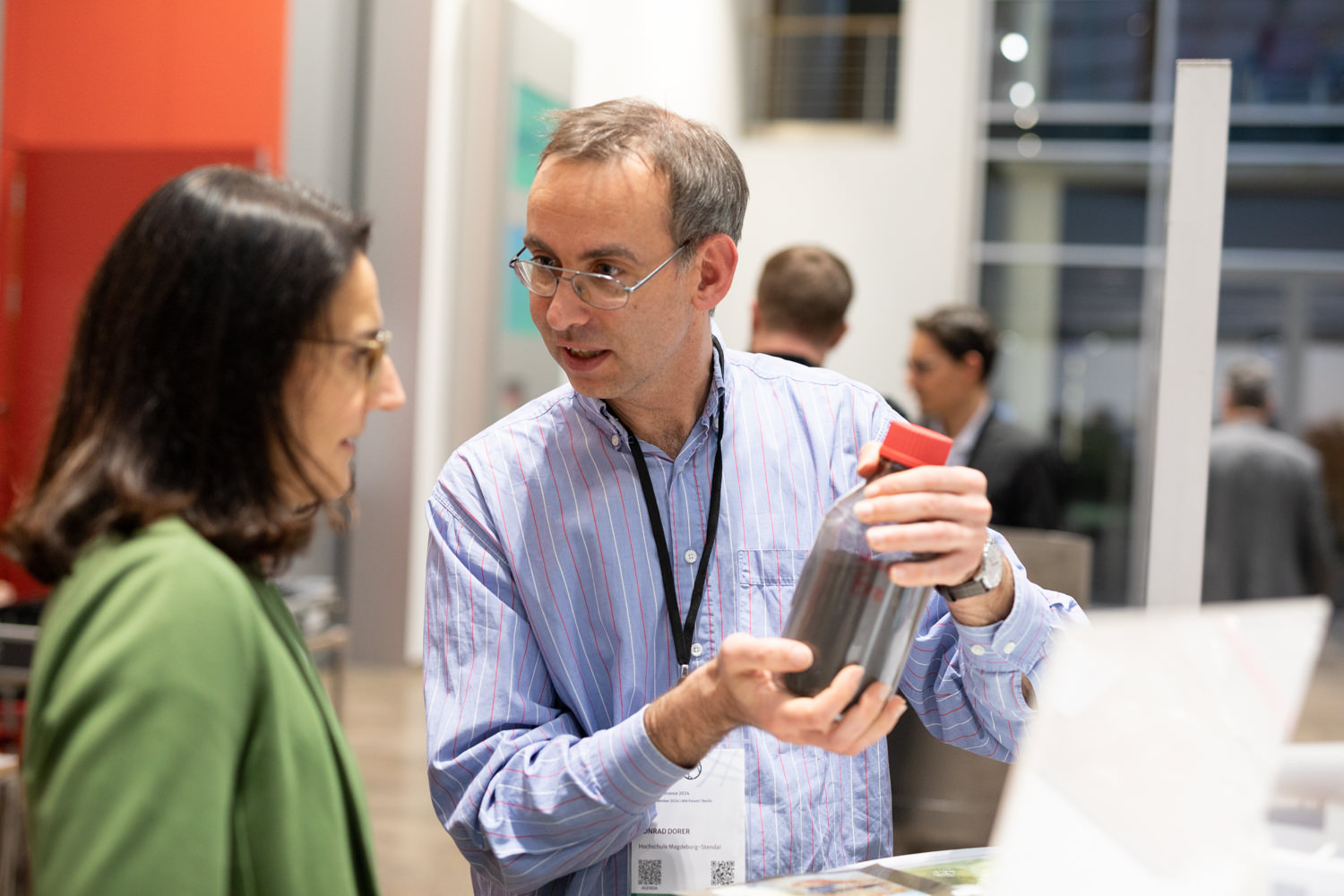
The exhibits from the RENO-TITAN and SAND! projects presented at the CLIENT Conference 2024 illustrated the journey from natural coastal sand to high-quality white pigment titanium dioxide, while also highlighting sustainable alternatives for the construction industry.
Exhibit 1:
Coastal mineral sand from the Vietnamese province of Binh Thuan forms the raw material. This sand contains up to 1% heavy minerals such as titanium-containing ilmenite, but also naturally occurring radioactive substances.
Exhibit 2:
The 0.063–0.125 mm grain size fraction of this sand contains visible ‘black grains’ – heavy minerals such as ilmenite. These are specifically enriched using mechanical processes until a heavy mineral concentrate is produced.
Exhibit 3:
The heavy mineral concentrate from Vietnam consists mainly of ilmenite, which is extracted from coastal sands using special processes. Radioactive substances are also enriched during this processing.
Exhibit 4:
The purified ilmenite mineral is particularly resistant to weathering. It is isolated from the sand using magnetic separators and electrostatic separation and serves as an important source of raw material for titanium dioxide production.
Exhibit 5:
Titanium dioxide, produced using the sulphate process, among others, is the most widely used white pigment in the world. It gives paints, plastics and paper exceptional opacity and a diamond-like shine. Production can generate residues that contain enriched natural radioactivity.
Exhibit 6:
Rice husk ash is presented as a sustainable additive: as a cement substitute, it significantly improves the ecological balance of concrete by reducing the CO₂ emissions of traditional cement production.
The exhibits clearly show how both mineral and agricultural resources can be used in innovative ways in the construction and industrial sectors.
More information about RENO-TITAN and SAND! can be found on the project pages.